Pages

Showing posts with label Time Not Content. Show all posts

Friday, March 30, 2012

Home Education on the Move

1 comment:
Moving is always a major upset in the realm of home education. You tear down your inspirational environment to be moved to a new location. It takes several weeks of packing and unpacking to get back to a semblance of "normal". This move is even harder because we are still in between homes, staying in a hotel and with family at various times while we look for a house. This is particularly challenging! It is hard to keep everyone focused on home education when there are so many distractions with extended family. There is also a big lack of enthusiasm for home education while staying in a hotel as it feels too much like a vacation.

Here are some things we do to stay on track during a move or while traveling:

  • Stick with the basics - Don't add new items, systems, or principles into the mix. Stick to a basic outline of simple topics and books. Do not start any new methods for education like a new writing program.
  • Travel light - Only take books you know you will use. The last time we moved we took too much that we never touched. Utilize eBooks and eBook Readers to make your book box even lighter. We use our laptop and Android tablet to read many free classics for Nook and Google Books.
  • Technology - Utilize resources online, both free and fee based, that do not require textbooks like Khan Academy, Aleks Math, Old Fashioned Education, Main Lessons (Baldwin Online Literature Website), Ambleside Online, and Netflix (lots of documentaries on Instant Play). Most hotels have free Wi-Fi as do McDonalds, Barnes & Noble, and public libraries. We were able to find open Wi-Fi spots by simply driving into the parking lot of McDonald's and did not need to go inside or buy anything.
If your travel time is short, it may be fine to just skip the Structure Time, not Content key. But, if you will be traveling for an extended period of time, it can feel overwhelming to miss too much study time. Plus, I find that too much time on their hands leads to losing progress and enthusiasm for working hard. With a little bit of planning and some flexibility on expecting rigorous study, keeping up with home education on the road can be accomplished without too much headache (just a little one).

Monday, November 28, 2011

Aleks Math

No comments:
We decided to try Aleks Math, an online math program. I was able to get a free two month trial membership to try it out for both of my Scholars. All I can say is we like it a lot! We used Math-U-See in the past, which we loved in the lower math levels, but when we got up to Geometry the kids started having trouble with it. I'm not even sure why, but it was not working.

We are 6 weeks into our trial and I'm thankful we found it. The first step after creating a log in is to choose a math subject. Next, the system gives the student a pre-test. Once the pre-test is done, the system shows you how much of the curriculum for that subject you know and how much you need to master. The mastery is shown as a "Math Pie". We have focused on mastery for the past few years and I find it keeps the kids more motivated.

We apply Structure Time, not Content with Math (see other posts on this key). The time structured is 30 minutes a day for my Scholars. They can choose any subjects in the "Math Pie" to study, allowing for individual preference. The system automatically assigns review questions periodically in order to make sure the student has mastered the topic.

The downside is the cost! It is pretty expensive in my book. From the Aleks website it is $99 per 6 months per student or $19.99 a month. The cheapest we were able to find it is through Leadership Education Academy (LEA), which is $99 for a 12-month subscription per student until Nov. 29th. After that, the price increases to $109 per student. It does include a semester of math mentoring. If you live in Utah, you can also sign-up for this class tuition free through their charter school option. There is also a 3 payment option with LEA.

Personally, it is only worth it in the higher maths. Once my Scholars are up into Algebra and above, I am not savvy enough to teach these subjects. There are several math subjects to choose from and the student can switch to another subject at any time. They also have an SAT Math study class, which is helpful for those getting into college strictly on SAT scores.

Monday, August 8, 2011

Yearly "School" Calendar

No comments:
After I have contemplated the Course of Study and made that plan, I typically decide on our "school calendar". Our state requires that we have a formal start and stop date. I have chosen July 1st for the last several years. Even if we do not officially do much in July, we include all of our studies during that month (books read, fieldtrips, classes, etc.) in our education hours. Some states require specific start dates, so check with your state laws before you determine a date to make sure you are in compliance.

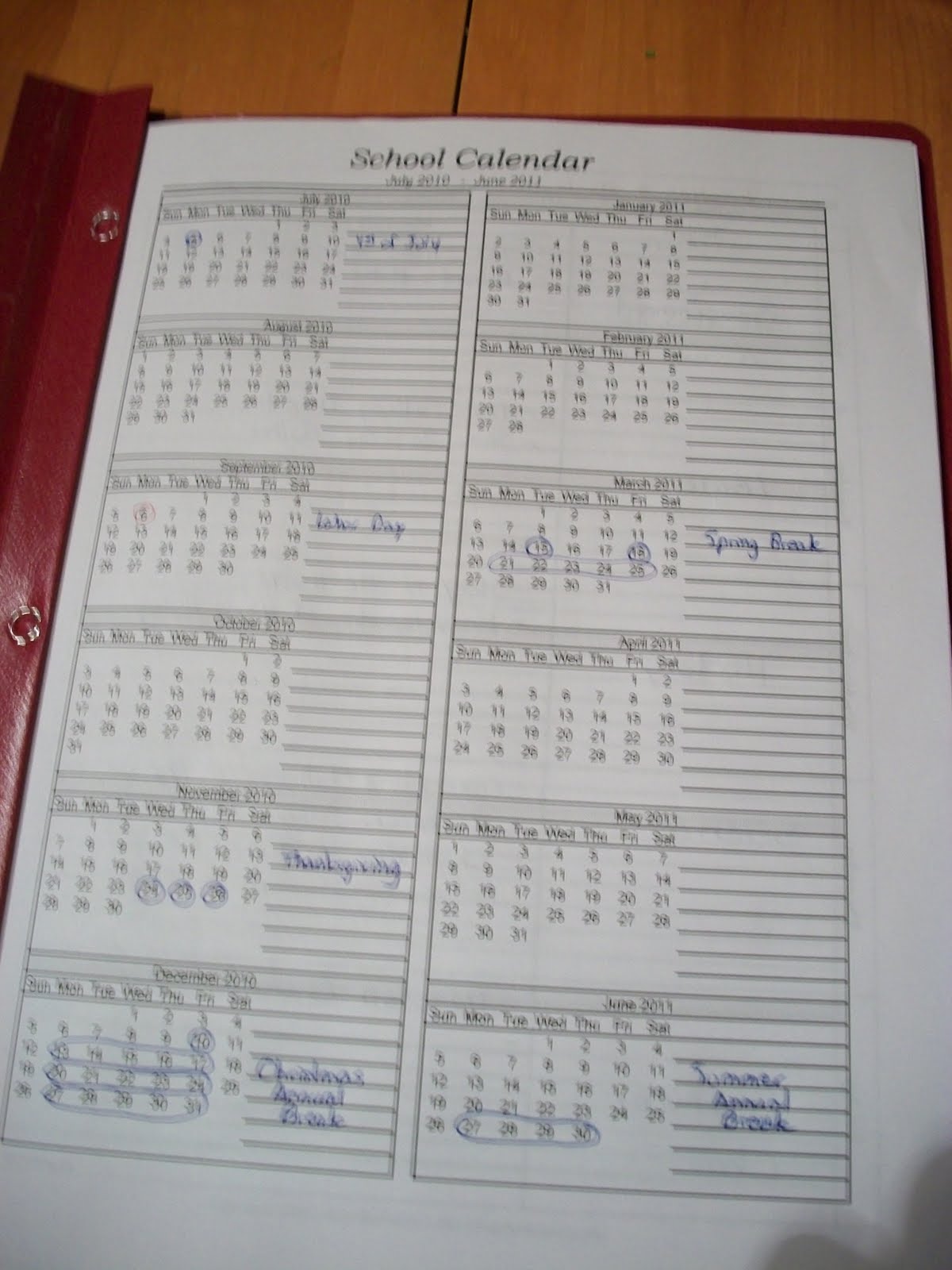
Again, I like donnayoung.org for her free forms. Here is a link to all the calendars she has available. I personally like the 12 month ruled calendar that fits all on one page. I place it in the beginning of my binder right after the Course of Study and before the weekly planner. I write in and/or circle the dates that we are "off" as a kind of attendance record. I am not required to send in attendance records, so this system makes it easy for me to give an accounting of days attended if we are ever asked. We school year round take two annual breaks a year, typically June and December. This year we are taking July off instead of June because of various camps and things we had going on.

Here is a picture of last year's calendar.

Monday, July 25, 2011

Getting it Together

1 comment:
When life throws you some curve balls, it can be hard to get back on track. Having challenges is part of life. We all have them at various times, some more than others it seems. With educating our children at home, we often find that difficult circumstances greatly alter our ability to stay with our education plan. We find ourselves detoured as we meet the challenges we face. Sometimes we are detoured far longer than we expected and it is easy to feel guilty, depressed, frustrated, or all of these things combined. If our trials have been of a very severe nature, like death, loss of job, new baby, etc. then we may find ourselves so discouraged that we may give up completely.

How do we overcome challenges that slow down our education?
  1. First, realizing that everyone will face challenges in life at some point makes it a bit easier. We need not feel alone or that we are the only one. Yes, other people's challenges will be different than ours, the focus is on that everyone HAS challenges that derail their education at some point, even though they may be very different in nature.
  2. Next, we need to not beat ourselves up over lost education time, passion for education, and loss in attitude towards education. When we face difficult trials in our lives, we turn to what is often called "survival mode". We cut back on things that are non-essential and turn towards getting through the day. This is a built in coping mechanism that is given to us by our creator to protect life first. We shouldn't feel guilty about doing this during the most difficult parts of our trials. Over time we can add more of the non-essentials back in. I know, how can education be non-essential? In terms of survival, education is not on the level of essentials, it takes back seat to food, shelter, safety, and personal relationships.
  3. The first two steps are mental preparation and giving ourselves permission to cut back. The third step is to look forward to a return to our educational plan in a timely manner. Depending on the trial, it could be months before you can return to a full educational path. Trials that derail us completely like death, severe health problems, and a new baby will take the longest to recover from. Trials of a financial nature, discipline problems, moving, etc. will often take a change in attitude and a few weeks to get back on track. You are the only one that can determine when you are ready to return. Your children may even be very happy to be off-track! That will discourage any mother and make you wonder why you do it all. But, you will find that one day you will feel inspired to return to the schedule and you will feel the pull to bring the family back to the way of education that you need.
  4. Once you feel that pull to return your family back to education, take some time to write notes or make a plan to ease back into the schedule. One of the most damaging things I've done in returning to our education plan was to "jump in with both feet". My children were suddenly told that the next day we were starting back to a full education schedule. It was a difficult day and I've learned since to add things in week by week rather than all at once. Usually it is the guilt that drives us to suddenly return to our education schedule in full force.
As we are getting it together after a month of trials, it feels good to get things back into action one step at a time. Our approach is to:
  1. Pick a date we will begin returning to our education schedule. For us, that will be after our oldest goes back to college. We decided to extend our annual break a few more weeks to allow us to have more quality family time together. Normally I would start to feel guilty about this, but with so many deaths and health issues in the family, I think we need this extra time.
  2. Decide what parts of our schedule are the most important to start first. One area that has crept in is a lot more entertainment than I normally allow. The first thing to change will be a reduction in our entertainment and to make the hours it is allowed to be firm again.
  3. Make a plan for which week to add in schedule/rules to the plan. Our next schedule changes will be adding in devotional, kid school, and classes outside the home. These will have various start dates and will be added into the schedule with a plan in place, knowing that our schedule will steadily increase in demands.
  4. Follow through with the plan to return to full education schedule. Knowing the plan helps everyone have an understanding of what is expected and when it will be expected. We typically discuss the schedule and the "step-up" plan a few weeks before we start it. Having the plan laid out helps everyone transition with a good attitude and makes the transition much less painful.
There will always be hiccups to any great plan. Learning to roll with it and adjust and tweak the plan as needed is important to remember. I'm feeling much better about our return to home education and hope to have a smooth transition.

Please share your tips and experience on getting back to home education after life's trials.

Sunday, May 1, 2011

They Aren't Doing Anything!

1 comment:
I used to worry extensively about my older children (Love of Learning and Practice Scholars at the time) seemingly "not doing anything". My conveyor-belt mind wanted to see worksheets, tests, and papers every day. I was worried they would not learn enough and that they would not keep up with grade levels.

For probably an entire year, we did no "formal math"...that's right...no worksheets, drills, tests, or lessons. We did play some math games and I pointed out areas of math that we were using in our every day life. One website that I used is Living Math, which I dutifully tried various ways of introducing math in fun ways.

Still.....no "formal math".

I wondered if they would ever pick up the higher maths.

Over the last year, Nayna (Self-Directed Scholar) has finished 3 "years" or levels of math. She completed Algebra I in just 5 months. She started on December 1, 2010 and told me yesterday that she was ready for the Final Exam, which she passed with an "A".

I would have never thought TJED would work with math. For some reason, I could just never get around my conveyor-belt education thinking with math. I figured I was loosing time and would need to force/require. Instead, what I did was Structure Time, not Content. I told them they need to do something "math" every day, it didn't matter if it was a Sudoku puzzle, measuring out ingredients for a cake, or figuring out a "real world" math problem.

Real World Math
One day Chris (Project Scholar), was trying to figure out the velocity of a figure in a game to make the figure slow down as he is being shot and loosing his energy. He has been trying his hand at game programming. When he showed me the problem to ask for help I thought, "This is advanced algebra, he has only formally studied up through fractions."

As he worked through the problem, I showed him math texts that we have that teach the concepts he wanted to know. He worked his way backward through the book in a few sections to figure out what he needed to know and then applied the math to his game programming. I was completely stunned that he was able to learn math that way.

I have always thought math had to be taught in a certain order...but I guess if a person wants the knowledge bad enough and they know where to find it, they can figure it out. I mean, how did Archimedes figure out machines and astrology? How did he discover Pi and how it applied to circles? No one was there to teach him each individual math concepts. He learned how to think and applied himself to the problem until he figured it out.

Monday, February 7, 2011

Weekly Planner #2

1 comment:
Nayna decided that she didn't want to use the Weekly Planner #1 anymore. She devised a specific planner to suit her needs. This planner includes all of the subjects she wants to study, planned out over the days she wants to study them. She checks off the subject and writes in the details (chapter or page numbers) of what she did that day.

I am really proud of her for coming up with her own study plan that is so detailed and specific for her needs. I think this is the main ingredient missing in so many homeschools. We bring our children home to give them personalized attention, but do we give them a personalized study plan or do we just bring the public school curriculum home?

Personalized Curriculum
My opinion is that if we are bringing the public school curriculum home we are missing the mark. Most of the "homeschool" curriculum out there is the SAME as the public schools. Public schools teach to the bottom 20% of students. Is this what we want for our children? It's not what I want.

When we personalize a curriculum for each child that is strongly based in classic works, we are teaching to the potential of our students rather than just to the "norms" of the public schools. If we are going to put in the effort to educate our children at home, shouldn't we make it worth our time?


Tuesday, October 5, 2010

New Plan - Check!

No comments:
With the addition of substitute teaching, I needed to come up with a new plan. I have become more of a list maker now that I am older. My brain just can't seem to store things in it's proper place as it used to. Things on the "priority list" seem to get dumped to the "things I can't remember list". Things I don't need to obsessively think about end up on the "priority list" and clog my thoughts with mundane tenacity. Thus... planners and lists have become my friends.

Planner #1
It first started with foster parenting that I began keeping a simple weekly planner for appointments and such. When we moved and stopped fostering I was happy to place that little planner in a drawer. Five months later I pulled it out when I realized that work, callings, and homeschool commitments were getting missed or I would reschedule because I couldn't remember something else was already planned. The main thing missing from my current planner is a weekly "To Do" list, a must have in next year's planner.

Mike likes to rub it in that he has a Palm (which I bought him two years ago for his birthday). I wish I could afford the fancy cell phone with data service and Blackberry apps. How sweet that would be! But, alas, our budget can't handle that kind of luxury. I guess I'll just have to cowboy up and use pen and paper. *sigh*

Planner #2
The second planner change was to add a check list type of planner for Nayna and Chris so that on the days that I am at work they do not get off track (keeps me on track too). They are both in Scholar Phase, but not all levels of Scholar Phase are the same. You can see this week's plan here. This is a form of Structure Time, not Content. They have certain criteria that needs to be done each day, but there is some choice as to fulfilling that criteria. We have been doing this for four weeks now and it is working really well. We had a few trial and error moments, but make-up work is a consequence...so my kiddos are much better at completing the list. ;-) The 2 child-planner sheet is from donnayoung.org. I filled in the basics that are the same each week and then copied the sheet. The things that change I just write in every week. I prepare this on Sunday during our Mentor Meetings (same as FEC meetings).

We still have our individual binders with student planners that I shared before. This one-page plan also has the appointments that affect them and the days that I work listed at the bottom.

Planner #3
My kids are very proficient at making meals, they have been for some time. We have come up with a system that the kids and I each make meals two nights a week, except Sunday. Mike is not home for dinner or he would take a turn in the rounds also (working 60-70 hours a week I figure makes up for it). You can see our meals listed here and who is cooking that night. The kids typically cook on the days that I work. Chris and Nayna can make a pretty awesome spaghetti from scratch.

Sunday is a day of rest for us. We typically eat left-overs or simple meals. I remember reading about Sister Kimball and that she didn't want to spend all day preparing meals on the Sabbath so she would prepare on Saturday. I felt that this applies to me, I also don't want anyone to slave away on Sunday in the kitchen.

Over time I have learned a great deal from Mike on organizing and planning. I'm thankful that I have a husband who values a "house of order" both temporally and spiritually.

Thursday, September 9, 2010

Part-Time Working Homeschool Mom

No comments:
I've had many questions about how I can possibly work part-time and still homeschool. Well...it is a bit tricky...

Job #1 - Kohl's
I worked a couple years ago part-time at night doing ad-set at Khol's...making a few cents above minimum wage. I often worked from 8pm until 2am two or three days a week, slept until 11am and then we did homeschool until just before dinner. That was difficult. I was always tired and sleeping was sporadic at best. However, the job was easy and I had great friends at work. I took that job to pay for court expenses and had that job when Mike was laid-off, a huge blessing as they gave me extra shifts and daytime work hours to help us get by. The main thing I miss from that job was the discount! Not that I can afford to shop there anymore.

Job #2 - Foster Care
After moving to Flagstaff we decided to become a Foster Family. This is NOT a part-time job, but a 24/7 endeavor to raise traumatized children. I spent all my time doing this and homeschooling was difficult to "fit in" sometimes. However, we learned a great deal from this, grew as a family, and learned to love and serve the less fortunate. We miss many of the children who lived with us and wish we could have kept little Bryce forever. The money was....well it is practically non-existent. Anyone who THINKS foster parents make money doing this is crazy.

Job #3 - Substitute Teaching
My current endeavor is to substitute teach part-time, one or two days a week. So far, so good. I make much more per hour than Kohl's or foster care (which I didn't make anything doing), I can choose to work or not work on any given day, and I can request more or less work days as needed. My young adults are doing the majority of their work while I am gone and I can check their progress, teach concepts that need my extra help, and oversee their education without too much being taken away from our routine. I have installed good work habits with my scholar phase kids and they are doing the same amount of work as if I was here. In fact, I think they are becoming much more responsible students.

Conclusion
Anyway, with our current status financially, I doubt I will be jobless again. We have missions and weddings to prepare for even after all our debts are paid. I miss the stay-at-home days. I had hoped to adopt and continue to be a mom at home, but it appears that this is not to be. **sigh**


Monday, May 24, 2010

Mistake #6 - Ignore the Written Agreement

3 comments:
Reference: Leadership Education by Oliver and Rachel DeMille, pages 212-224.

This is an area that I needed to work on. I only had a written agreement with my son that I did two years ago and it had more to do with him choosing to be here than about academic work.. My daughter is so intently particular about her education that I never felt like I needed one with her. I can see that the biggest problem is me. I am a lax mentor at times. I do not always follow through with checking over their progress and their work. In fact, I have about 2 weeks worth of journal writings to read. I tend to procrastinate the feedback part of mentoring. I find that I am more of a "weekly check-in" type of mentor.

Basically I realized I need to get my act together and that this is an area that I am making BIG mistakes in!

I decided to work on written agreements as follows based on the level of Scholar Phase:

Practice Scholar Agreement - see Leadership Education pages197-204.
"Do not make a formal scholar agreement with your student yet; just give her a daily option of doing Scholar studies that are more demanding than her normal Love of Learning schedule. It is not going backwards if she is on for a while, then off. For most kids this is normal and healthier than just going into Scholar and never backtracking into Love of Learning. Expect her to back out numerous times in the first one to two years. Support her when she does." - Leadership Education, pages 202-203
I was relieved after re-reading this passage. My agreement with my son is more of a commitment to educate himself at home since he went back to public school a couple years ago for a few weeks. That agreement was about him choosing to be at home and not bouncing between school and home. It worked really well, but most families will not need this at all unless you are detoxing your children from public school.

The main part of our agreement is a verbal one that study time is between 9am and 5pm...there are NO electronics unless for researching an approved topic or typing up a written assignment. Television is only used for watching items like a recorded Shakespeare play or a classic movie I have chosen as part of their education. After 6pm and all the family work is done, free-time allows for some limited TV and game play.

With Chris, I have found that in the beginning of Practice Scholar he leaned heavily towards Love of Learning and rarely towards Scholar. In the last couple of months he is gaining momentum on Scholar Phase and spends a larger portion of his day studying and reading. I don't have to ask or prod, he just chooses to do so.

Project Scholar Agreement - I am basing these items on Leadership Education pages 204-207. Another factor in considering what to include in a written agreement is learning styles and personal mission.

ResponsibilitiesBenefits
Family Responsibilities - Your own laundry once a week and Family Work chart as designated.

Ownership of responsibilities, not errands.

Study Hours:

  • Daily: 9am - 5pm
  • Weekly: Mon.- Fri.
Yearly Breaks:

  • June and December
  • Weeks of YW Camp and Youth Conference.
Assignments:

  • Daily - Written summary due 5pm.
  • Weekly - Fill-in own Scholar planner.
Mentoring:

  • Getting a great education.
  • Pursuing your mission with mentoring as needed.


Act like a Young Adult in morality and righteousness.

To be treated like a Young Adult in the home instead of a child.

Act like a Young Adult in continnual nurturing of relationships in the family.To be included as a Young Adult by parents in settings outside the home, instead of a child.

This is a basic agreement and the one we are putting into practice has some specifics added that apply just to Marly. All I can say is that I am SOOO glad I decided to study the mistakes that can be made in Scholar Phase so that I could correct myself and gain better mentoring habits.

Tuesday, May 18, 2010

Mistake #3 - Give Them Too Much Non-Academic Work

1 comment:
Reference: Leadership Education by Oliver and Rachel DeMille, pages 214-216
"They cannot get to Scholar Phase education if you will not let them." - Leadership Education, page 215
I remember having this problem when I was growing up. I loved reading! It was the highlight of my life in middle and high school. I loved to bring home the maximum number of books from the school library and read all afternoon and evening long. Often, I would go to the library during lunch to exchange my books throughout the week. I was well known in the library and the librarian would often recommend other titles for me to read based on the books I liked. She was probably my most beloved mentor during that period of my life.

At home, I was the oldest of seven children. My parents struggled and my home life was less than ideal. My mother often suffered from depression and would lock herself in her room once I got home from school. From the time I got home until my father came home (sometimes until I went to bed) I was in charge. The burden of parenting fell on my shoulders often and my beloved books, and often my homework, would have to wait. There were times when I was told to "stop wasting my time reading books" and "get up off my butt and help the family." Another favorite of my father's was to "stop hiding" in my books. My childhood was shortened and my responsibility towards the family dominated my life until I left home at an early age.

My story is extreme, but it happens to a lesser extent in many homes.
"Young people who read all day are not lazy. They are students. And it is tempting to want to help them "balance" their lives. But compared to the non-scholar generation they are living in, and the level of leadership that will be required to face upcoming generational challenges, these few youth are the "balance". And we need thousands more to achieve a good balance. There are only a few of them in America, it is true, but there should be more. And if you happen to have one in your home, or three or four, you have done something right. But do not shut them down. Let them do it!" - Leadership Education, page 216
Because of my own experience, I do not think I have done this to my children. Even when we had foster children with severe emotional and behavioral needs, I worked hard to limit my dependency on my older children to help. That does not mean that they didn't help, because they did (they need to mentor others some of the time), but if I could do it myself...I did it myself. It is tempting to ask them to help often, they are so handy to have around!

We did have our children mentor the foster children at times, paying special attention to Structure Time not Content. During our official study hours, I did not ask my children to help the younger children. During non-study times, they were sometimes asked to mentor a younger child in getting ready, picking out clothes, playing games, eating their food, etc. My main focus was not to burden my children with what is my responsibility.

Note: You may be wondering about other types non-academic work...we'll talk about that in the next few posts.

Sunday, May 16, 2010

Mistake #2 - Start Them Too Early

3 comments:
Oliver DeMille in Leadership Education stated that starting kids too early in any phase of learning "is committed the most frequently of all the mistakes." I have found this to be one of the mistakes I have made the most often as well. Why? I think it is because we are so used to Conveyor-belt testing, grade levels, and "norms" that we find ourselves easily thinking, "my child should be doing ___________ by now". Mentoring parents can easily make this mistake at ALL of the transitions between phases, especially between Core and Love of Learning, and Love of Learning and Scholar. It's kind of like putting the cart before the horse.
Even the prodigy who reads and plays piano at age three needs a full and wonderful Core Phase. Part of Core is discovery and play, so your brilliant son can discover and play at caluculus or physics or literary analysis at age five if he wants, but do not put him in Scholar until the Core Lessons are fully and clearly learned. Right and wrong, good and bad, true and false are lessons that exceptionally intelligent and gifted people often struggle with, so if your child is a prodigy he likely needs a longer, fuller Core Phase than anyone else. In play time he can study whatever he wants. - Leadership Education, pages 213-214
I am not sure any of my children are prodigies per se, they are all very talented human beings with abilities that stretch far beyond anything I have ever taught them. I have found that once a child has shown a certain level of genius about a topic I seem to want to expect that same level of genius every time they engage in that topic. I believe that is the folly here, expecting brilliance every time a child shows interest or genius in a subject, talent, or project. Much of the Core and Love of Learning phase is spent exploring...trying things out...and yes, occasionally knocking our socks off with what they can do.

The concern is expectation. It seems to me that our expectations are what push us to want to start children too early in a phase rather than allowing them to want to be in that phase all the time. It is easy to tell when we are pushing...a time of "Hate of Learning" seems to come creeping in. I heard things like, "you take all the fun out of everything" or "I don't want to read __________" or "I hate math". It was time to back off and evaluate what I was doing and why. Sometimes swallowing my pride and expectations is what I needed to do. Sometimes I just needed to switch things up with more hands-on activities or fieldtrips.

Has this ever happened to you?

Friday, January 15, 2010

Jan. '10 - Week 2

5 comments:
With some new changes to our schedule, we have had to restructure our Time and not Content. We are now doing school from 10am to 3pm, rather than 9am to 2pm. Marly and Chris have to fulfill the Daily Lessons within these hours and fill the other time with educational projects and individual study.

:: Daily Lessons ::
  • Devotional: "Preach My Gospel" - Finished Lesson 1 and started Lesson 2 - a section a day.
  • Read A-Loud Book: "The Long Winter" book #6 of Little House on the Prairie series.
  • Math: Chris - Math-U-See: Delta - Marly - Math-U-See: Zeta - Celeste - Math-U-See: Algebra (review for mom...again!)
  • Exercise - We are using the Wii Fit Plus while "the weather outside is frightful". It is harder than it looks!
  • Writing - Chris - daily journal entries. Marly - writing her own book and Transformational Writing class assignments (see Marly's projects for more info.)
  • Guitar Practice
  • New Era and Ensign Reading, Scripture Reading, and Individual Reading - See each person below for their readings.
:: Weekly Lessons ::
  • Monday: Grammar Lessons - Chris: "Winston Grammar" - Adjectives - Marly: "Grammatically Correct" - Study subjects and objects.
  • Tuesday: Guitar Lessons, Government Lesson, and Weekly Library Trip - "The 5,000 Year Leap" - Principle 11.
  • Wednesday: Mutual/Scouts and History Lesson - Chris: "Story of the World", Vol. 2, Chapter 9 - Marly: "Story of the World", Vol. 3, Chapter 1.
  • Thursday: Homeschool Friends Outing
  • Friday: Science Lesson - "Concepts and Challenges in Physical Science" Chapter 3.2 - Energy.
:: Individual Readings ::
  • Chris (Practice Scholar) - "Jubal Sackett", Scriptures, and New Era magazine.
  • Marly (Project Scholar) - "The Fellowship of the Ring", Scriptures, and New Era magazine.
  • Celeste (Mentored Scholar - back to looking for a mentor) - "The Fourth Turning", Ensign and New Era magazines, Scriptures, and Primary Lesson.
:: Projects ::
  • Chris - More Palm programming in C language, learning Java programming, book report (still choosing which book).
  • Marly - Transformational Writing class at TJED Academy and Prep School and Seminary. Latin - Latina Christiana I - Lessons 1 and 2.
  • Celeste - Tax preparations, purging broken toys, getting items ready to sell (truck, exercise equipment, entertainment center, etc.) in preparation for getting ready to move. Latin - Latina Christiana I - Lessons 1 and 2.
  • Family - Ice removal in driveway, wood stacking.

Saturday, September 5, 2009

September '09 - Week 1

No comments:
OK, I'm a bit late getting this out. Life has been busy, busy, busy. We made a few changes to our education plan and family work. With the addition of foster children coming and going, we had to make a few adjustments.
  1. A chore wheel rather than assignments. This makes it easier on me. Each of my children can easily be assigned a "buddy" to help with the chores without me having to change the entire plan each time children come and go.
  2. We have a list of "Daily Expectations" and "Weekly Lesson Schedule". (See Mom Notes).
Together Lessons

Devotional
- "Let Him Ask of God" daily inspirational readings.

Government - "The 5,000 Year Leap" by Cleon Skousen - Part I - Discussion on how the Founding Fathers did not want the US to become a "welfare state".

Science - "Concepts and Challenges in Physical Science" - Gravity - "Chemistry for Every Kid" - Experiment #21.

Latin - Latina Christiana I - more review of Lessons 1-3.

Family Projects - Reading: "On the Banks of Plum Creek" - Young Jammers - My kids started a fantastic free program where they are learning Guitar and Harmonica.


Individual Phases and Studies

Marlayna (Project Scholar) - Projects: Guitar practice. - History: Story of the World 2 - Chapter 34 - Reading: "Wizard Heir", "Princess Ben", "Utopia" (The real one by Thomas Moore). - Math: Math-U-See: Epsilon.

Christian (Love of Learner) - Projects: Guitar practice. - History - Story of the World 2 - Chapter 3 - Reading: "Wizard Heir", "Beyond the Deepwoods" - Math: Math-U-See: Delta

Mom (Ready to be a Mentored Scholar - but, still looking for a Mentor) - Reading: "King Arthur: Tales from the Round Table", "The Communist Manifesto" - Math: Math-U-See Algebra

Mom Notes: "Daily Expectations" are a list of what I feel my children should work on each day. This includes a math lesson, review grammar and spelling rules, daily reading, daily journal entries, etc. By giving my Scholars these expectations, I feel it has enriched their focus on what they need to know to be successful in life.

"Weekly Lesson Schedule" is a basic outline of what we will do together each day (Kids School). Monday - Grammar & Spelling Lesson (rules reviewed throughout the week), Tuesday - Government Lesson, Wednesday - History Lesson, Thursday - PE, Friday - Science Lesson and experiment, Spelling Test.

Tuesday, July 21, 2009

Detox

4 comments:
One of the mistakes I made when I first brought my children home was to push them. I have found that they need some time to "detox". It takes a good six months, which scares most people away from doing it, yet it is one of the MOST IMPORTANT things you can do to switch gears from public education to home education. During detox, we had the following rules:
  1. No TV, video games, or computers during school hours - 9am-1pm at our house - 30 minutes break for lunch.
  2. During school hours they were to keep busy with - books, educational games (board games, card games, etc.), educational toys, and educational videos that were on the approved list (included many classic movies).
  3. I encouraged them to start projects - like building models, learning to crochet, painting, coloring, etc. These projects were also considered "school".
  4. The only required participation was to Mom School - which is when I teach what is mine. Mom School includes our read-a-loud book and whatever else I decide to teach that day.
During this "detox" time, I spent my "school hours" working on my own education, for myself and as an example to my children. How do you know when detox is over? Easy! They start choosing to learn on their own, they ask questions and want your feedback, and they start coming up with their own goals. You find a child with a book they can't put down or a project they HAVE to finish.

I hope this all makes sense. It is so easy to do what we did as children and so hard to change and do something else.

Wednesday, April 2, 2008

Key #4 - Time, Not Content

No comments:
Structuring TIME and not the CONTENT is hard in any education setting. It is difficult to let go of preconceived ideas from my conveyor belt education and let my children truly gain a lasting education by choosing what they want to learn, when they want to learn it, and how they want to learn it. For me, I have to constantly remind myself to let go and allow the children to explore subjects and freely determine for themselves that a subject is needful. Once they truly feel it is needful, nothing can stop them!

Our schedule is loose and easy. I spend the majority of my time trying to inspire my children to education by allowing them to see examples of myself in my Scholar Phase. This is harder to do some days than others.

Recently, Marly has been transitioning into Scholar Phase and I find her reading most of the day. It amazes me that her determination to learn and grow is coming from her...not me. If I resorted to requiring and choosing the content, I would need to stand over her all day (like a teacher at public school) and make sure she is doing everything I wanted her to do. Instead, I am seeing HER take the lead and show me all that she is learning. Amazing, but true! We have a 14 year old girl who loves learning, has a plan, and follows through without much prompting from anyone else.

Thursday, March 27, 2008

Eight Keys of Great Teaching

No comments:
This used to be Seven Keys of Great Teaching, but Dr. Oliver DeMille added a new key in his new book "Leadership Education: The Phases of Learning". I feel that these keys are useful to every family - home schooled, public schooled, or charter school.
  1. Classics, not Textbooks
  2. Mentors, not Professors
  3. Quality, not Conformity
  4. Time, not Content
  5. Inspire, not Require
  6. Simplicity, not Complexity
  7. You, not Them
  8. Secure, not Stress - NEW!
My first instinct when reading this list was, "I can do this!" and then it changed to, "HOW do I do this?" Over the next few months I will post about each KEY to Great Teaching.